New Orleans is famous for its food, festivals, nightlife, and architecture, but perhaps its greatest contribution to American culture is jazz music. From the brass bands marching through neighborhood streets to the smoky clubs of the French Quarter, jazz has been part of New Orleans life for more than a century.
Widely recognized as the birthplace of jazz, New Orleans produced some of the most influential musicians in American history, including Louis Armstrong, Jelly Roll Morton, Sidney Bechet, and King Oliver.
The music that developed here eventually spread across the United States and around the world, influencing everything from swing and blues to rock and roll, R&B, funk, and modern popular music.
What makes New Orleans jazz particularly interesting is that it didn’t begin in fancy concert halls. It developed in the streets, dance halls, neighborhood gatherings, funeral processions, and working-class communities of a growing port city.
Today, jazz remains a major part of the city’s identity, and visitors can still experience many of the musical traditions that helped make New Orleans famous.
The Birth of Jazz in New Orleans
Jazz began taking shape in New Orleans during the late nineteenth and early twentieth centuries.
At the time, New Orleans was one of America’s busiest port cities, bringing together people and musical traditions from Africa, the Caribbean, Europe, and throughout the United States.
The city’s African American communities played the central role in developing the new musical style, drawing upon blues, spirituals, ragtime, African rhythmic traditions, and the popular dance music of the period.
European-style military marches and brass bands also influenced the developing sound.
Unlike traditional orchestras, where musicians generally played written arrangements, early jazz musicians experimented with improvisation, syncopated rhythms, and playing different melodies simultaneously.
This approach created a lively and unpredictable form of music that was particularly popular at dances and neighborhood celebrations.
By the early 1900s, jazz had become a recognizable part of New Orleans entertainment.
Congo Square and the African Roots of Jazz
One of the most historically significant locations in the development of jazz is Congo Square, located inside Louis Armstrong Park near the French Quarter.
During the eighteenth and nineteenth centuries, enslaved Africans gathered in this area on Sundays, participating in music, dancing, drumming, and other cultural traditions.
These gatherings helped preserve African rhythms and musical practices in New Orleans when many other American cities severely restricted such expressions.
Although modern jazz developed generations later through many influences, Congo Square represents an important foundation of New Orleans musical culture.
Today, visitors can explore Congo Square in Louis Armstrong Park, just across North Rampart Street from the French Quarter.
It’s a worthwhile historical stop for anyone interested in understanding where New Orleans music began.
Buddy Bolden and the First Jazz Bands
When discussing the earliest jazz musicians, one name frequently comes up: Charles “Buddy” Bolden.
Born in New Orleans in 1877, Bolden was a cornet player and bandleader who became a local celebrity during the 1890s and early 1900s.
His music incorporated blues influences, powerful brass playing, and improvisation that helped distinguish his performances from more traditional dance bands.
Bolden and his musicians played dances, outdoor gatherings, and neighborhood entertainment venues around the city.
He became particularly famous for his loud, expressive cornet playing.
Some music historians consider Bolden one of the first true jazz musicians, although jazz developed through the contributions of many performers rather than a single inventor.
Unfortunately, no authenticated recordings of Bolden’s performances survive.
Much of what we know about his music comes from recollections of musicians and people who heard him play.
His career ended in 1907 following serious mental health difficulties, but his reputation as a pioneer of New Orleans jazz has continued for more than a century.
Storyville and the Early New Orleans Jazz Scene
Another important chapter in New Orleans jazz history involves Storyville, the city’s former legal red-light district.
Established in 1897 and closed in 1917, Storyville occupied an area just north of the French Quarter.
The district contained saloons, dance venues, gambling establishments, and other businesses that occasionally employed musicians.
Jazz pianists and small musical groups found work performing for customers, while larger bands played throughout the surrounding neighborhoods.
Jelly Roll Morton was among the musicians associated with the Storyville era.
However, the idea that jazz was invented entirely in Storyville is a misconception. The music was developing across New Orleans, particularly in African American neighborhoods, social clubs, parade traditions, and dance halls.
The closure of Storyville in 1917 is often mentioned as an important event in jazz history, but it was only one of several factors that encouraged musicians to seek opportunities in other cities.
Louis Armstrong: New Orleans’ Most Famous Jazz Musician
No history of New Orleans jazz would be complete without Louis Armstrong.
Born in New Orleans in 1901, Armstrong grew up in a poor neighborhood and developed his musical abilities during his youth.
He eventually became one of the most influential trumpet players, singers, and entertainers of the twentieth century.
Armstrong learned from earlier New Orleans musicians, particularly cornet player Joe “King” Oliver.
In 1922, Armstrong moved to Chicago to join Oliver’s Creole Jazz Band.
His extraordinary technical abilities and improvisational style quickly attracted attention.
During the 1920s, Armstrong made a series of groundbreaking recordings with his Hot Five and Hot Seven groups.
These recordings helped transform jazz by placing greater emphasis on the individual soloist rather than only collective group improvisation.
Armstrong also became famous for his distinctive singing voice and scat singing, using improvised syllables instead of conventional lyrics.
His later recordings included internationally recognized songs such as “What a Wonderful World” and “Hello, Dolly!”
Although Armstrong spent much of his professional career outside Louisiana, he remained closely associated with his hometown.
Today, New Orleans honors Armstrong with Louis Armstrong Park, Louis Armstrong New Orleans International Airport, and numerous musical celebrations.
His influence on jazz and American popular music is difficult to overstate.
Other Legendary New Orleans Jazz Musicians
Louis Armstrong may be the city’s most famous musician, but he was part of an extraordinary generation of performers.
Jelly Roll Morton
Ferdinand “Jelly Roll” Morton was a pianist, composer, and bandleader who helped introduce more structured arrangements into jazz music.
Born in New Orleans, Morton combined ragtime, blues, and improvisation into sophisticated compositions.
His recordings with the Red Hot Peppers during the 1920s became landmarks in early jazz history.
Morton famously claimed to have invented jazz, an assertion that historians generally reject, but his contributions to jazz composition were substantial.
Joe “King” Oliver
King Oliver was an important cornet player and bandleader who helped establish the New Orleans jazz sound.
Oliver’s Creole Jazz Band became famous in Chicago during the 1920s and introduced wider audiences to musicians including Louis Armstrong.
His influence on Armstrong and the development of trumpet improvisation was especially important.
Sidney Bechet
Sidney Bechet was another pioneering New Orleans musician who became internationally famous.
A clarinetist and soprano saxophonist, Bechet was recognized for his expressive playing and remarkable improvisational ability.
He performed internationally and became especially popular in France, where he spent much of his later life.
Edward “Kid” Ory
Kid Ory was an influential trombonist and bandleader whose performances helped establish the traditional New Orleans ensemble sound.
His playing contributed to the distinctive combination of trumpet, clarinet, and trombone that became associated with early jazz.
Lil Hardin Armstrong
Women also played important roles in the development of jazz, including pianist, composer, and bandleader Lil Hardin Armstrong.
She was a member of King Oliver’s Creole Jazz Band and performed on Louis Armstrong’s influential Hot Five recordings.
Her musical abilities and encouragement helped Armstrong advance his career, and she also established herself as an accomplished musician.
What Makes Traditional New Orleans Jazz Different?
Traditional New Orleans jazz has several recognizable characteristics.
One of the most distinctive is collective improvisation, where multiple musicians play complementary musical lines simultaneously.
In a typical early jazz ensemble, the trumpet or cornet carries the primary melody, while the clarinet adds more elaborate musical phrases and the trombone provides lower harmonies and rhythmic accents.
Instruments such as the banjo, piano, upright bass, tuba, and drums maintain the rhythm.
The result is a lively, layered musical sound where individual performers have considerable freedom while still working together as a group.
Much of the early music was designed for dancing rather than quiet listening.
This remains one of the defining characteristics of New Orleans jazz: the music encourages audience participation, movement, and celebration.
Jazz Funerals and New Orleans Second-Line Parades
One of the most unusual and recognizable New Orleans traditions is the jazz funeral.
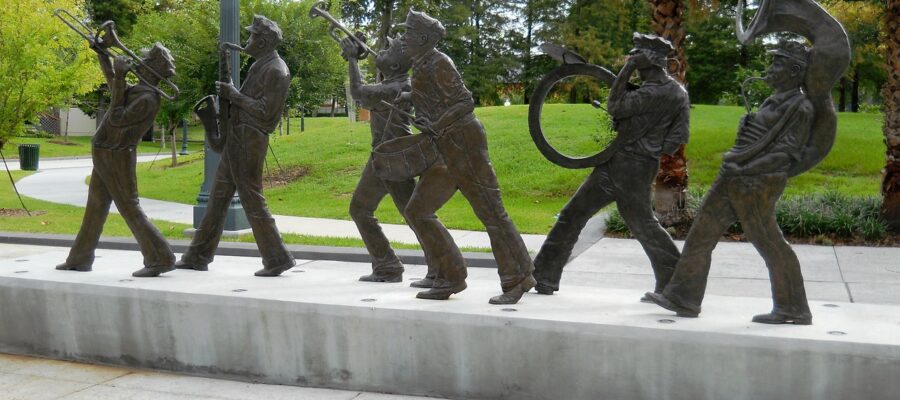
For generations, brass bands have participated in funeral processions, especially within the city’s African American communities.
Traditional jazz funerals often begin with solemn hymns or slower music as mourners accompany the deceased.
After the burial or another appropriate point in the ceremony, the band may begin playing upbeat songs to celebrate the person’s life.
The music becomes lively, and participants dance and march through the streets.
The tradition reflects a combination of African American cultural practices, religious customs, neighborhood organizations, and the city’s long history of brass band music.
What Is a Second Line?
A second line is a parade tradition closely connected to New Orleans brass bands and community celebrations.
The first line traditionally consists of the parade organizers, honored participants, and musicians.
The second line consists of the people who follow behind, dancing and celebrating to the band’s music.
Participants frequently carry decorated umbrellas, wave handkerchiefs, and perform distinctive dance steps.
Second lines aren’t limited to funerals. They are also associated with weddings, festivals, birthdays, neighborhood celebrations, and annual parades organized by social aid and pleasure clubs.
Visitors sometimes encounter second lines while exploring New Orleans, particularly on weekends.
They are among the most authentic examples of how the city’s musical traditions continue to thrive.
How New Orleans Jazz Spread Around the World
By the 1910s and 1920s, New Orleans jazz musicians were traveling throughout the United States.
Chicago became a particularly important destination, offering professional opportunities in dance halls, clubs, and recording studios.
New York City also emerged as a major jazz center.
Traveling musicians introduced New Orleans-style music to new audiences, while riverboats operating on the Mississippi helped carry jazz to other communities along the river.
In 1917, the Original Dixieland Jazz Band, a white group with New Orleans roots, made what is generally recognized as the first commercially released jazz recording.
Although Black New Orleans musicians had been developing the music for years, the popularity of recorded jazz helped introduce the style to a much larger audience.
During the 1920s, jazz became a national sensation, and the decade became known as the Jazz Age.
Jazz continued evolving through swing, bebop, cool jazz, hard bop, and numerous other styles.
Despite these changes, the early music of New Orleans remained an important foundation of the genre.
Preserving New Orleans Jazz: Preservation Hall
By the middle of the twentieth century, traditional New Orleans jazz faced growing competition from newer musical styles.
Rock and roll, rhythm and blues, and modern jazz were attracting younger audiences, while many early jazz musicians were aging or struggling to find regular work.
During the 1950s and early 1960s, efforts to preserve traditional New Orleans jazz gained momentum.
One of the most important developments was the establishment of Preservation Hall in the French Quarter.
Located at 726 St. Peter Street, Preservation Hall grew out of informal jazz performances organized in a local art gallery.
Allan and Sandra Jaffe became closely involved in the project and helped turn it into a permanent home for traditional New Orleans jazz.
The Preservation Hall Jazz Band eventually began touring, introducing new generations of listeners around the world to the music.
Today, Preservation Hall remains one of New Orleans’ most celebrated jazz venues, offering intimate live performances featuring local musicians.
For visitors interested in traditional jazz, it is one of the best places to experience the music in a historically significant setting.
Modern New Orleans Jazz and Brass Bands
Jazz in New Orleans didn’t stop evolving with Louis Armstrong and the early pioneers.
During the late twentieth century, a new generation of musicians began combining traditional brass band music with funk, soul, R&B, and hip-hop.
Groups such as the Dirty Dozen Brass Band and Rebirth Brass Band helped modernize the sound while maintaining strong connections to New Orleans parade traditions.
Musicians including the Marsalis family, Kermit Ruffins, and Trombone Shorty have also helped bring New Orleans music to new audiences.
Trombone Shorty, in particular, has become known for incorporating jazz, funk, rock, and R&B into energetic performances.
Modern New Orleans music reflects the same cultural exchange and experimentation that produced jazz more than a century ago.
The instruments and rhythms may change, but the tradition of innovation continues.
The New Orleans Jazz & Heritage Festival
One of the biggest celebrations of the city’s musical heritage is the annual New Orleans Jazz & Heritage Festival, commonly called Jazz Fest.
The first festival took place in 1970, with performers including Mahalia Jackson, Duke Ellington, Pete Fountain, Al Hirt, Fats Domino, and numerous local musicians.
The festival gradually grew into one of the country’s most recognized music events.
Today, Jazz Fest includes much more than traditional jazz. Performances feature blues, gospel, Cajun music, zydeco, funk, rock, R&B, and numerous other musical styles associated with Louisiana and beyond.
Traditional food, Louisiana artwork, cultural demonstrations, and heritage exhibits are also major parts of the festival.
Jazz Fest is a particularly good opportunity to experience the variety of music that developed in and around New Orleans.
Official information is available from the New Orleans Jazz & Heritage Festival.
Where to Experience Jazz History in New Orleans Today
Visitors interested in jazz history will find several worthwhile attractions around the French Quarter and surrounding neighborhoods.
Preservation Hall
Located on St. Peter Street, Preservation Hall offers traditional jazz performances in a historic and intimate setting.
Frenchmen Street
Just outside the French Quarter, Frenchmen Street is one of the city’s best-known areas for live music.
The neighborhood features music clubs, bars, and performance venues offering traditional jazz, brass bands, funk, and other styles.
It’s an excellent place to explore New Orleans’ current music scene.
New Orleans Jazz Museum
Located in the historic Old U.S. Mint at 400 Esplanade Avenue, the New Orleans Jazz Museum features exhibits, historical artifacts, educational programs, and musical performances.
It’s an excellent stop for visitors who want to understand the history of the city’s musicians and musical traditions.
New Orleans Jazz National Historical Park
Operated by the National Park Service, the New Orleans Jazz National Historical Park offers educational programs, exhibits, and live musical performances.
The park’s French Quarter visitor center is located at 419 Decatur Street.
Congo Square and Louis Armstrong Park
Congo Square is one of the city’s most significant historical music landmarks.
Walking through the park provides an opportunity to explore the African musical traditions that contributed to the development of jazz.
Jazz Cruises on the Mississippi River
Another enjoyable way to experience New Orleans jazz is aboard a Mississippi River paddlewheel cruise.
The Steamboat Natchez and other riverboats offer selected sightseeing, lunch, and dinner cruises featuring live jazz performances.
These excursions combine music with views of the Mississippi River and the city’s historic waterfront.
Why New Orleans Is Still the Home of Jazz
More than a century after the earliest jazz bands began performing, New Orleans remains one of the world’s most important musical cities.
Unlike places where jazz is primarily associated with concert halls or special performances, New Orleans incorporates music into everyday life.
Brass bands still march through neighborhoods. Musicians perform in local clubs, festivals, restaurants, and outdoor gatherings. Children grow up hearing the music that generations of performers played before them.
The city’s musical identity is continuously changing, but its traditions remain connected to the past.
For visitors, experiencing live jazz is an essential part of discovering New Orleans.
Whether you’re listening to a traditional band in the French Quarter, following a second-line parade, or enjoying music on a Mississippi River cruise, you’re participating in a musical tradition that helped shape American culture.
And that’s what makes New Orleans different from almost anywhere else in the world: jazz isn’t simply something the city remembers. It’s something the city continues to live.